
Environmental Due Diligence: Understanding Risk Before Investment

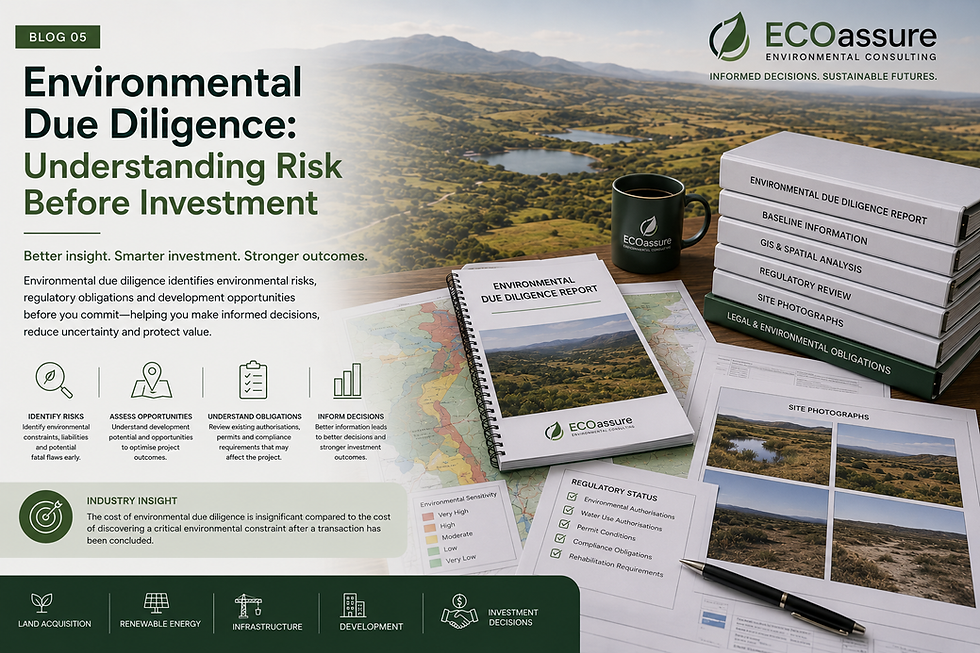
Whether acquiring land, evaluating a development opportunity or investing in infrastructure, decisions are often made based on financial, technical and commercial considerations.
However, environmental factors can significantly influence project feasibility, timelines, costs and long-term viability.
Environmental due diligence provides a structured approach to identifying environmental opportunities, constraints, liabilities and regulatory considerations before commitments are made. While it is often viewed as a compliance exercise, effective due diligence is ultimately about informed decision-making and reducing uncertainty.
What is Environmental Due Diligence?
Environmental due diligence is the process of evaluating environmental risks, obligations and opportunities associated with a property, project or transaction.
The objective is not simply to identify environmental constraints. It is to understand how environmental factors may influence development potential, permitting requirements, project costs, programme risks and future liabilities.
Depending on the nature of the transaction, environmental due diligence may consider biodiversity sensitivities, water resources, heritage constraints, planning restrictions, existing authorisations, compliance history, contaminated land risks and stakeholder considerations.
Practical Lesson
Environmental due diligence is most valuable when undertaken before critical commercial decisions are made, not after a transaction has already been concluded.
Understanding Environmental Constraints
One of the most common outcomes of environmental due diligence is the identification of environmental constraints that may influence development.
These may include:
Protected areas and biodiversity priorities.
Wetlands and watercourses.
Heritage and archaeological resources.
Agricultural potential.
Land use planning restrictions.
Infrastructure servitudes.
Aviation and telecommunications constraints.
Existing environmental obligations.
Not all constraints prevent development. However, understanding them early allows project teams to make informed decisions regarding site selection, project design and permitting strategies.
Practical Lesson
A constraint identified before acquisition can often be managed. A constraint identified after acquisition may become a costly project risk.
Existing Rights and Regulatory Obligations
Many projects inherit environmental obligations that are not immediately apparent during commercial negotiations.
These may include:
Existing environmental authorisations.
Permit conditions.
Water use authorisations.
Rehabilitation obligations.
Compliance commitments.
Monitoring requirements.
Environmental management plans.
Failure to understand these obligations can create unforeseen responsibilities, additional costs and regulatory challenges.
Practical Lesson
Environmental liabilities are not always visible on the ground. Many exist within permits, authorisations and historical commitments.
Assessing Development Potential
Environmental due diligence should not focus exclusively on risk.
Understanding opportunities is equally important. Environmental screening, spatial analysis and regulatory reviews can provide valuable insight into the suitability of a site for a particular type of development.
In many cases, due diligence helps refine project concepts, identify alternative development areas and improve project planning before significant resources are committed.
Practical Lesson
The purpose of due diligence is not to find reasons to avoid development. It is to support better development decisions.
The Role of GIS and Spatial Intelligence
Modern due diligence increasingly relies on GIS and spatial intelligence to integrate multiple environmental datasets into a single decision-support framework.
Spatial analysis can assist in identifying:
Environmental sensitivities.
Development opportunities.
Infrastructure access.
Land use conflicts.
Regulatory constraints.
Potential fatal flaws.
When applied early, GIS provides a powerful mechanism for reducing uncertainty and informing investment decisions.
Practical Lesson
Good decisions are rarely based on a single dataset. They emerge from understanding how multiple environmental, technical and planning considerations interact across a landscape.
Identifying Fatal Flaws Early
One of the most important objectives of environmental due diligence is the identification of fatal flaws before significant investment occurs.
Fatal flaws may include:
Unsuitable environmental characteristics.
Regulatory barriers.
Unacceptable environmental impacts.
Significant stakeholder conflicts.
Development constraints that cannot reasonably be mitigated.
While not all projects contain fatal flaws, identifying them early can prevent substantial expenditure on opportunities that are unlikely to progress successfully.
Practical Lesson
The cost of identifying a fatal flaw early is almost always lower than discovering it after acquisition, design development or permitting has commenced.
Looking Beyond Compliance
Environmental due diligence is often associated with compliance and risk management. However, its greatest value lies in improving decision-making.
By understanding environmental realities before commitments are made, organisations can reduce uncertainty, manage risk, improve project planning and make more informed investment decisions.
Projects that undertake meaningful due diligence are generally better positioned to navigate environmental approvals, stakeholder engagement and project implementation because many of the key risks have already been identified and considered.
Industry Insight
The cost of environmental due diligence is insignificant compared to the cost of discovering a critical environmental constraint after a transaction has been concluded. The earlier environmental considerations are integrated into investment and development decisions, the greater the opportunity to reduce risk, improve certainty and support successful project outcomes.


Comments